

by John Mark Shaver FAIRMONT NEWS EDITOR Mar 29, 2026
Submitted photo
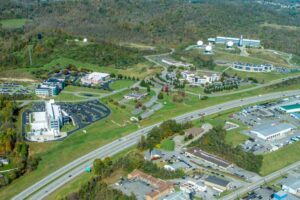
FAIRMONT, W.Va. — The West Virginia High Technology Foundation has its sights set firmly on the future of the I-79 High Tech Park and what it could mean for North Central West Virginia as federal anchors invest more money and resources in the area.
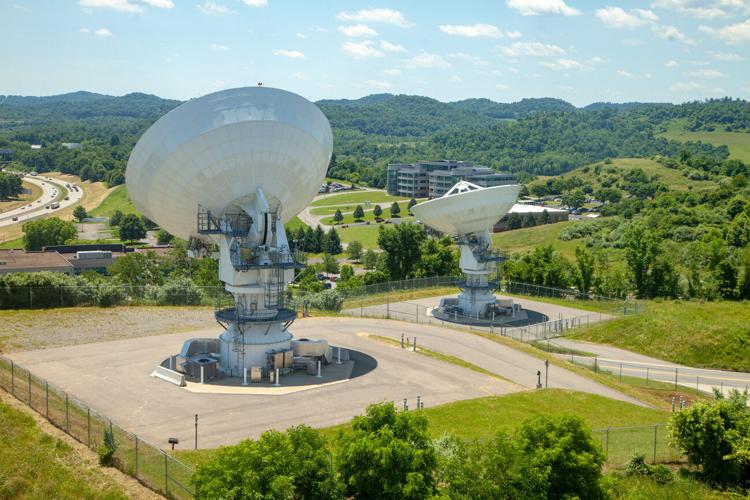
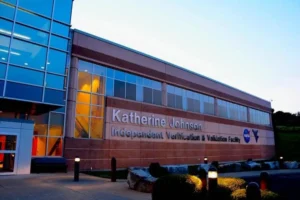
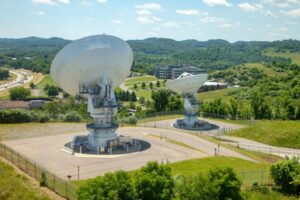
WVHTF President and CEO Jim Estep said that as of the organization’s last count, the I-79 High Tech Park has more than 1,200 employees spread across different companies and agencies. Two of the park’s biggest employers are NASA’s Katherine Johnson Independent Validation and Verification Facility and NOAA’s Environmental Security Computing Center.
These federal anchors, Estep said, are crucial to the park’s success.
“They are helping us establish the business case to grow the knowledge or technology sector in our region,” Estep said. “That’s important because West Virginia has to participate in the nation’s knowledge sector if it wants to have a healthy economy. …
“Further, West Virginia has been 50th in educational attainment for 50 years. The only way we’re going to correct that important economic factor is by creating jobs that require education beyond high school, and recruiting federal anchors is the best strategy to do that.”
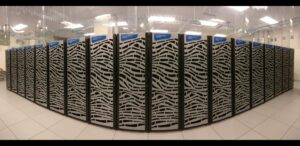
In 2024, NOAA announced that it will be installing a $100 million supercomputer named Rhea at its Fairmont location. Estep said that as the park works to provide more infrastructure for NOAA’s needs, the buzz and activity in the area should generate “significant business interest and start-up growth.”
One of the ways the foundation plans to increase its capacity at the park is through its Phase III expansion project, which the organization has been working on for the past decade. The access road to this new section has been built, and crews are currently working to get pads ready for new development.
“I’m very hopeful that we’ll be able to kick that expansion into high gear in late 2026 or early 2027,” Estep said. “Part of that expansion is going to include additional power generation capabilities for the park, more advanced telecommunications infrastructure, and possibly some data center activity.”
Additionally, a pad is being constructed behind the Robert H. Mollohan Research Center to support “AI supercomputers” that Estep said NOAA will bring to the park in the coming years. He explained that these supercomputers will be used to build AI products from NOAA data and allow the agency to adopt a “more authentic AI infrastructure.”
For the last several years, the foundation has also been working on what Estep called the Ecosystem Project. This project would see the park help develop an ecosystem of innovation and entrepreneurship in the region that would directly support the commercial climate and weather industry.
To that end, the High Tech Foundation and NOAA partnered with West Virginia University to create the Cloud Data Analytics Fellows Program with the goal of exposing students to the fledgling market.
“Having the various NOAA operations that we have here at Fairmont gives us an advantage in terms of building a component of that market in our region,” Estep said. “The rapid growth of agentic artificial intelligence over the last two years has now made that technology the almost exclusive development tool for software applications. If you combine the growth of agentic AI and its application to this ecosystem we’re trying to develop, then we now find ourselves in a strategic leverage position to participate in the multi-trillion-dollar AI market.”
Submitted photo
Estep said he is deeply impressed with the advancement of agentic AI over the past couple of years, noting that he believes it will transform every corner of life in a way similar to the internet.
He explained that agentic artificial intelligence is a rapidly evolving tool that works to accomplish goals with less input and supervision than generative AI, with the mission of making decisions as human-like as possible.
“That intelligence allows you to iterate to get better results and do more complicated use cases,” Estep said. “I can say from a personal perspective, I’ve never seen a technology be more transformational or have more potential in terms of software systems development as I see agentic AI. I believe agentic AI is going to disrupt virtually every sector you can imagine. Places where you never imagined software systems could operate will be operating over the next two to three years.”
Since NOAA plans to grow its AI capabilities at its Fairmont location, Estep said nearly every sector will want to use NOAA’s data produced in north-central West Virginia, which he thinks will be huge for business growth opportunities.
“We’ve never had an economic opportunity of this magnitude that could have a truly transformational impact and address what I consider to be our most significant economic handicap, and that is our educational attainment,” Estep said. “Educational attainment is measured by taking a snapshot of the workforce and measuring how many jobs in the existing workforce require an education beyond high school. The more jobs that are created in the workforce demographic that have that requirement are going to, by default, increase our ranking.”
Estep said that as NOAA works to increase its AI capabilities over the next two years, the foundation will develop new power plans to generate more resources to support the economic growth he expects.
“My observation is that over the next year or year and a half, NOAA will be not only expanding its artificial intelligence activities, but also be very aggressive in making this data available through cloud platforms,” he said. “I’m hoping that within the next three years, we start seeing tangible, measurable growth of what I’m describing.”
Fairmont News Editor John Mark Shaver can be reached at 304-844-8485 or jshaver@theet.com.
Article as originally published by The Fairmont News on March 29, 2026.