


FAIRMONT, W.Va. (WV News) — As artificial intelligence continues to evolve and spread deeper into everyday life, West Virginia High Technology Foundation President and CEO Jim Estep wants the state to capitalize on AI’s developments to drive economic development and job growth.
The future of artificial intelligence lies in its total integration with the internet, creating a world in which people will interact with AI as often as they interact with online services today, Estep said.
“It’s a big topic, but I don’t think people are comprehending just how significant of a change AI is causing,” he said.
Estep compared the rapid acceleration of AI to the transformation that took place in the early 1990s when the World Wide Web was first introduced.
“When ChatGPT came out, it demonstrated that you could … take all of this data from the web to create a foundation model that contains incredible amounts of information, then create an application that sits on top of that and allows you to use natural language to communicate with this model.”
AI has demonstrated a new model for building software, Estep said.
“You have to have some sort of operating system — whether it’s Microsoft or Linux or Mac — to build your applications on,” he said. “But those aren’t ‘intelligent’ operating systems. It’s a huge evolutionary jump in the core operating system for building applications.”
Estep said this “evolutionary jump” of a model is growing on the internet, with software using large language models — or “AI agents” — to complete users’ goals while doing much of the work that users did in the past.
In the near future, the internet as a whole will be a mesh of these AI agents, creating an artificial intelligence-driven internet called the “agentic web” that will outlast the potential bursting of the AI bubble, Estep said.
“There’s always a hype cycle for any new technology or sector,” Estep said, citing the “dot-com bubble” of the early 2000s.
“It’s hyped up while everyone is trying to figure out what’s what,” he said. Agentic AI will not be immune to the hype cycle. However, at the end of the day, the internet transformed everything and gave birth to things like cloud computing, which define everything today. The same will be true for AI. There’s hype, but it will level out and be the new way we do things. It’s inevitable. It will be, foundationally, the way all systems operate in the future.”
The agentic web will spur job growth, creating new positions for the changed landscape, Estep said.
Even more important, he said, is the potential for economic growth in West Virginia as the foundation works more closely with the National Oceanic and Atmospheric Administration, which has a key data center in the I-79 High Technology Park in Fairmont.
“We’ve been helping NOAA for some time to figure out ways to make its data more available so they can get society more involved in weather adaptation and readiness,” Estep said. “This agentic AI environment that’s rapidly evolving represents a powerful tool for us to achieve that goal for them.”
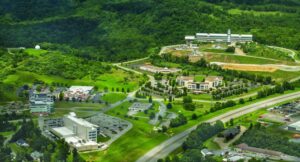
Submitted Photo
AI could be used to capture some of the commercial climate and weather market in the region, Estep said.
“It’s a multibillion-dollar opportunity, so if we can leverage agentic AI to build applications for weather readiness, I think we could really attract some of these opportunities to our region,” he said.
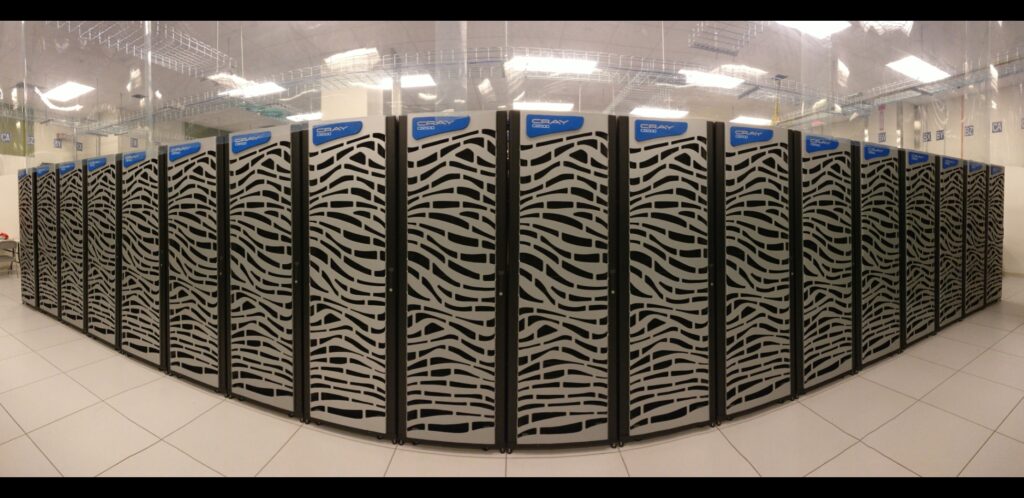
NOAA is set to bring a $100 million supercomputer to its Fairmont facility in early 2026. The computer will be instrumental in advancing the agentic web and weather application goals, Estep said. Additionally, the High Technology Foundation has partnered with West Virginia University to form the Cloud Data Analytics Fellows Program.
Through the program, Estep said, initiatives are being created to expose the student population to the concept of the agentic web and the creation and deployment of agentic AI applications related to weather readiness and the commercial sector.
“Every business sector there is will have to move to some type of agentic AI implementation,” Estep said. “That will create a number of new potential opportunities for innovation that we’re probably not even thinking about.”
West Virginia needs to expose its citizens to AI and give them thoughts and ideas on how to exploit it, Estep said.
“That involves training, education and outreach, but also us taking advantage of the significant AI activity NOAA is sponsoring at the park, because that will facilitate the ability to interact with AI that no other region will have,” he said.
Fairmont News Editor John Mark Shaver can be reached at 304-844-8485 or jshaver@theet.com.
Article as originally published by The State Journal on September 8, 2025.